








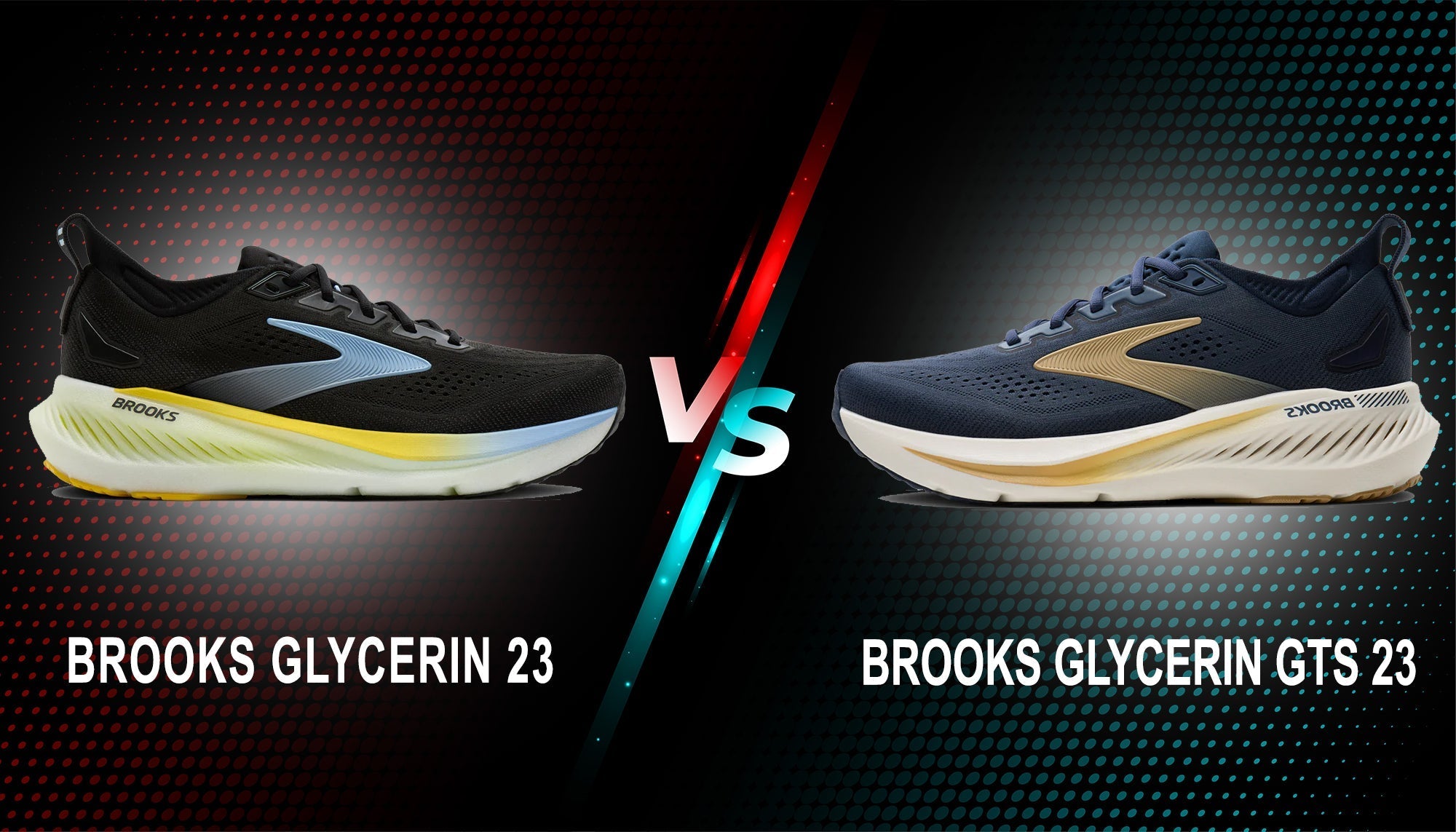
Brooks Glycerin 23 vs Glycerin GTS 23: Complete 2026 Comparison for Road Runners

Brooks Glycerin 23 vs Glycerin GTS 23: Which one is for you?
When Brooks launches a new shoe, the running world pays attention. And when that shoe is the Glycerin 23, the anticipation multiplies. But then a second version appears—the Glycerin GTS 23—and many runners scratch their heads, wondering: what's the difference? Which one do I need? Don't worry, that's what we're here for. Today, we're giving you the definitive comparison between these two sister shoes so you can make the best decision before hitting the pavement.
Brooks Glycerin 23 and GTS 23: What's inside
Let's start with what they have in common, which is a lot. Both shoes share the same technological base: DNA LOFT v3 foam, the softest and most responsive Brooks has developed to date. It's a triple-density foam that combines lightness, cushioning, and energy return in a truly balanced way. If you've ever run in a shoe that seemed to absorb every impact without making you feel heavy, you know what we're talking about.
Both also feature an engineered mesh upper that softly wraps the foot and allows for more than adequate ventilation during long runs. The tongue is soft, without aggressive seams, and the heel is well-structured to prevent that annoying heel slip we hate so much when accumulating miles.
So far, so similar. Now for the important part: the big difference between the standard Glycerin 23 and the GTS version is the GuideRails system. The Glycerin GTS 23 incorporates this lateral guiding system that acts as dynamic support for the knee and hip, without interfering with your natural movement. It's not a conventional control shoe, but rather a shoe that accompanies your stride and stabilizes it when needed. The Glycerin 23 without GTS, on the other hand, is completely neutral: it allows your foot to move with total freedom on the foam.
Who are they for and where do they excel?
Here's where something fundamental comes into play: knowing yourself as a runner. Because the choice between one and the other is not a matter of which is better in absolute terms, but which is better for you.
The standard Brooks Glycerin 23 is designed for the neutral runner looking for maximum cushioning without any additional support. If you have an efficient stride, good biomechanics, and have been running for a long time without recurrent joint injuries, this is your shoe. It's ideal for long runs on asphalt, for marathons, for those Sundays when you log 25 or 30 kilometers and need your foot to feel like it's floating. It also works very well on soft mixed surfaces, although its natural habitat is the pavement.
The Brooks Glycerin GTS 23, on the other hand, is the perfect option if you're a runner who notices instability in your knee or hip, if you tend to moderate overpronation, or if you've simply been looking for a shoe that gives you that extra bit of security without switching to a rigid control model. The GuideRails system doesn't aggressively correct your stride: it simply intervenes when your movement deviates from the optimal range. For many runners, especially those who accumulate many weekly miles on asphalt and seek to protect their joints in the long term, this is the smartest choice.
As for terrain, both are shoes designed exclusively for asphalt and hard surfaces. They are not designed for trail running or technical terrain. Their outsole, cushioning, and general construction point to the road, the urban park, the athletic track, or that cobblestone street where you love to run at dawn.
Our opinion from ADS Running
We've been wearing and recommending shoes for years, and rarely does a range generate such consistently good reviews as Brooks' Glycerin. The 23rd version takes a step forward in softness and finishes compared to its predecessors, and it shows from the first kilometer.
If we had to recommend without knowing anything about the runner, we would say this: if in doubt, go for the GTS. The GuideRails system doesn't penalize neutral runners, but it does protect those who need it. It's a more versatile shoe from a preventive point of view. However, if you are an experienced runner with a confirmed neutral stride and just want the freest and softest possible feel, the Glycerin 23 without GTS will give you exactly that.
In both cases, we are talking about one of the most complete maximum cushioning shoes on the market right now. They are well-built, last for many kilometers, and the level of comfort they offer on long runs on asphalt is hard to beat in this product range. If you are looking for a shoe to protect your legs on heavy training days, either one will more than suffice.
What is clear is that Brooks has put a lot of care into this generation, and it shows in every detail: from the foam to the upper, as well as a last that fits well on a wide variety of foot morphologies. It's not a fast shoe, nor does it pretend to be. It's a shoe that cares, that protects, and that allows you to keep running day after day without your joints paying the price.
Ready to try it? Get your Brooks Glycerin 23 vs Glycerin GTS 23 now at ADS Running with fast shipping and expert advice. 🏃


Leave a comment
This site is protected by hCaptcha and the hCaptcha Privacy Policy and Terms of Service apply.